Friday, July 24, 2009

In a Lonely Place

It is easy to miss where the title for In a Lonely Place (1950) comes from, but its placement seems hardly non-incidental. In one scene, when Dixon Steele (Humphrey Bogart) is discussing with a detective (Art Smith) and his wife who suspect him of murdering a writer (Martha Stewart) whose novel he is supposed to adapt in to a screenplay, he describes who he think the killer really is and how he did it; ‘ They come to a lonely place…he stops the car and puts his arm around her neck…’ He manages to coerce the detective in to acting out the exact maneuver on his wife, and then persuades him, his gleeful face shadowed with backlighting, to squeeze ‘harder…harder…"

Naturally, Dixon scares the wits out of the detective and his wife. Naturally, he is also a writer by profession. In a Lonely Place is not about a killer or a crime. It is not a whodunit. It is about the gray area that divides poets from psychos.


The director is Nicholas Ray, who would later be one of the original Hollywood filmmakers to be heralded as an Auteur by the French New Wave critics, but in this film, there is no evidence that points to him as the distinctive voice of the film; the screenplay was penned by Edmund North and Andrew Solt, from a story by Dorothy B. Hughes. (That this grim film came from the mind of a woman does not seem too surprising, once one considers how central a role the female perspective on Bogart’s character plays.) The writers crafted a film not just about a writer, but also about the craft of writing; it is Bogart, worn out, pockmarked face and short, intense hair, who completes their story and truly makes the film his own. His Dixon Steele is a has-been screenwriter who did his best work before the war, has a history of casual violence and has now resorted to alcoholism and womanizing. When he is hired to adapt Mildred Atkinson’s book, he does not even bother to read it. Instead, he invites the writer to his home so she can tell him the story, which she does, with great enthusiasm. Steele acts as though he has heard the story a million times before and is not paying full attention; he notices his neighbor, Laurel Gray (Gloria Grahame) spying on him from her apartment window. He escorts Ms. Atkinson to the door at the end of the night, and the camera fades out on her figure as she leaves under his stone archway leading out of his yard.

The very next day, Steele is being questioned in regards to her murder. He insists he is innocent, but his nonchalant manner and the sociopathic accuracy with which he is able to deduce the details of Atkinson’s murder—not to mention his past record—all lead the police to suspect otherwise. Soon Laurel Gray is brought in for questioning and, although she too suspects him of having a sinister character, she soon finds herself in love with Dixon. Dixon, too, seems for once to have real feeling for someone, but two questions remain; did he kill Mildred Atkinson or not? Will he kill again?

In a Lonely Place is often characterized as a film noir, but this label should be taken lightly. It is not pure film noir, as the chiaroscuro is not pronounced enough, the women are not backstabbing dames and the city itself is only seen in glimpses and never despairing urban expressions. Though not a noir rule, the detectives are not the central characters, leaving even the distinction of detective story out of range. In a Lonely Place takes several quintessential noir elements and magnifies them; the witty and bitter dialogue (“You were nice. Not to me. But you were nice.”) provides many cynical chuckles, much needed in relation to the other magnified aspect; the mangled, pathetic realms of the soul. More so, it is about where those realms turn in to art. Bogart’s Dixon is a tormented man who expects no sympathy and gets none, aside from signs of a wasted talent that could only potentially be revived. Towards the end, he is only trying to pull himself together when he falls apart again. Bogart moves as if he doesn’t care what the camera sees of him; and the camera sees everything. It’s perhaps one of the best screen performances by an American actor, free of histrionics and sentimentality.

One of the more curious aspects of In a Lonely Place—and this only in retrospect, almost sixty years on—is the feeling that if it were made today, it may be considered far too silly to be taken seriously. Audiences would find it to be a Tarantino rip-off, with too outrageous dialogue (though I doubt Tarantino would ever be able to write this script), music that is too incessant and obvious. It would be a movie that’s saying nothing unusual; yes, artists are crazy, yes Hollywood corrupts. Next. The simple, often static camerawork would be praised as modest at best. In a Lonely Place is a movie that we must conclude is dated and severely of it’s time. Yet perhaps this is one more reason to see it. And in regards to raw acting, physical, oral and psychological, it is still unparalleled.
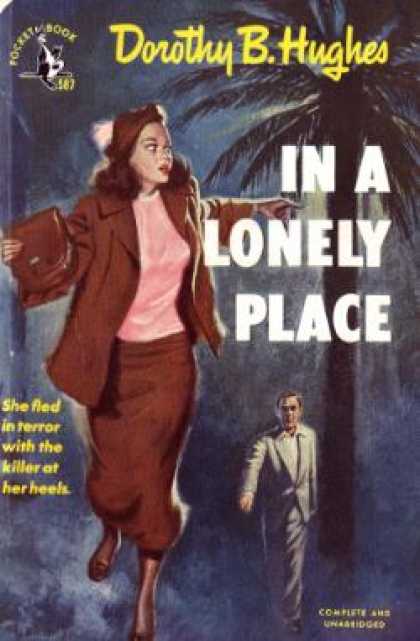
(cover of Dorothy B Hughes' original novel, 1947)


Sunday, July 19, 2009

Conservative Imagery Alert: Blind Pig who want to Fly

[This is not a film review. I did not have to time or resources to do one for this film, although someone else better.]
I recommend to everybody an Indonesian film called Blind Pig who wants to Fly ( Indonesia, 2008). The film contains numerous examples of clean, direct, traditional imagery such as:
-The opening shot. Two women are playing badminton. The camera is positioned behind the woman who we will follow on-and-off throughout the film, a Chinese minority woman in Indonesia. She is returning every shot of her opponent. The shot is in slow motion. Cut to a shot of the badminton ball soaring back and forth over the net. A voice off camera asks 'Which one is Indonesian?'
- A pig standing in the middle of a grassy, hilly landscape. He wants to get across a thin rope line that is stretched taught before him; we do not see where it is tied. The pig barely moves, but continues to grunt. 
- A girl demonstrating how she can swallow a firecracker. She puts it in a bread-roll, sticks it in her mouth and lights it. Camera rests calmly on her equally blank expression as the flame sizzles down to the exploding point. Cut to black when the explosion comes. 
These are all bizarre images layered with significance relating to the struggles of the chinese minority in Indonesia. Also to be commended, though, are the way this film cuts; from a man looking in to the mirror preparing to make an incision above his eye to the singular sun, blaring like a gigantic eye. It is the type of film in which it's imagery becomes more fun and peculiar after the fact, when mulled over in our heads. 
Blind Pig is structured in sketches preceded by titles (such as the title of the film), though it eventually plays loose with this device. It revolves around three or four characters, mainly, though even this it plays loose with. There is something about it's looseness that can be criticized and something elusive about the culture we are witnessing that is hard to grasp unless the problems arising with the chinese after Indonesia gained sovereignty in the 1940's is explained. But the quietness and conservatism of it's imagery are to be admired.
The film was screened at the Old American Can Factory in Brooklyn recently, as part of the Rooftop Films series. The director, who simply calls himself Edwin, was present, and did a question and answer session following the screening. It is doubtful that this film will be coming to 'a theater near you' anytime soon; we have no choice but to consider it an oddity-- and it is odd by any standard-- that you will have to catch at a film festival. 


Thursday, July 16, 2009

Tony Manero


Tony Manero contains one of the more forceful expressions of distaste for Grease ever committed to celluloid. When Raul Peralta (Alfredo Castro) arrives at his local Cineplex intending to see, yet again, Saturday Night Fever, he is informed it has left town, but he can buy a ticket for John Travolta’s more recent film. Raul takes his chances, as he does so many other times in this film, and does not like what he sees. He leaves the theater while the film is still running and enters to projection room, where he proceeds to grab the projectionist and bash his head against the projector until he drops dead. The projectors are still whirring as Raul paces across the room, resolutely unaffected by his deed.

            It is in this scene—the most deadpan and outrageous in the film—that Tony Manero’s palette is painted in its grimmest intentions. There have been numerous stories of movie-love and its consequences on our everyday lives, but Tony Manero is the sickest, most bad-omen bearing one yet. There are many other scenes in which Raul, the demented protagonist, played with a sleepwalker-type of creepiness by Alfredo Castro, is obsessing over John Travolta’s character, Tony Manero, in Saturday Night Fever. Each one bears out the notion that Raul is someone who uses the movie as just another outlet for getting the satisfaction he wants. In the course of the film, he will kill at least two other people and involve his friends and girlfriend in his scheme to emulate Tony Manero, only to alienate them whenever he feels like it. The film has been recognized by some as a political allegory of Chile’s Pinochet regime. While the political allegory is there, it is more helpful, especially for non-Chilean’s, to first recognize the film as a very unusual treatise on how media enhances our desires and delusions.

            The political context is of course, impossible to separate from the story. The year is 1978, at the height of Pinochet’s dictatorship. Raul has signed up to go on a television contest in which he will dress up as, and dance as, Tony Manero, with the intention of winning the award for the ‘Chilean John Travolta.’ The rest of the film happens in the week between his initial mistaken arrival at the television studio (he is a week early), and the actual contest. In the meantime, he rehearses with his friends and sort-of girlfriend for a separate act in which they will perform a dance number as the troupe from Saturday Night Fever. Raul lives in a dilapidated building that looks like a boarding house, though we can’t be too certain; every building in this Chile is dilapidated and made of crumbling brick and rotting wood. Just as the buildings are falling apart, everybody is impoverished; Raul makes repeated visits to a junkyard to collect glass plates with which he will reconstruct the floor from Saturday Night Fever, and when he realizes that a frail woman he has walked home has a color T.V, he bludgeons her and takes it. The need for commodities is an important thread running through the film, but what is most interesting is how the police-state nature of the country keeps distracting people from this need; several instances of police brutality are featured, both as a result of the anti-Pinochet activities of Raul’s friends and acquaintances.

            As a portrait of a dictatorship and of a man completely unaffected by his society (or, one could argue, affected to the point of apathy), Tony Manero undoubtedly paints a realistic picture of a most undesirable time in one nation’s history, but director Pablo Larrain is not careful enough to let the harsh-reality feel of the movie avoid monotony. From the first scene onwards, Raul is so obviously a creep, that we are never able to reflect on his actions or contemplate his character. Castro is an actor who had more control than actors often have over his performance, as he collaborated with Larrain on the script. But he chooses to play Raul as the most repellent individual the movies can offer, full of blank stares, vague communication and pent-up rage. The only hint of a root cause of Raul’s disturbed nature is the fact that he is impotent. Otherwise, we are only left to ponder what is a given in the first few minutes of the film; that this is what a dictatorship does to a society, and this is how movies affect a crazy person. This might work if the film did not play itself as a character study. The way Raul sulks around for the rest of this bleak and naturalistic film makes him come off as the least realistic person in all of Chile; if we want to see an equivalent of his character, all we have to do is look at a grainy photo of a murderer in a tabloid newspaper. No larger metaphor can raise this killer above caricature.

            Only in the last scene do we get a tense display of where the movie wants to work; as a bizarre portrait of loneliness and the limits of imitation. The final scene is also the only one set not in a crumbling urban dystopia, but a sunny suburb; had Larrain chosen to set more of the film in the colorful, and therefore eerier, suburbs of a dictatorship, our preconceptions would be dispelled, and we might be more willing to simply label Castro’s character ‘crazy’ and live with it.

At the end of the film, one walks away feeling properly chilled, but not quite satisfied in a cinematic sense. The film is overall exemplary of the state in which foreign cinema has been in for years; built from gray, shaky cinematography that hits us over the head with it’s harsh realism, long takes not for the sake of the story, but for the aesthetic coolness of long takes and no music at all, just because. In a way, it makes one wish that Truffaut and Bazin had never called for films to become naturalistic, or that certain directors such as Antonioni had not ingrained these traits so deeply in to cinema. Foreign cinema is not really helping itself in this regard, even though it continues to produce filmmakers with fascinating subjects on their minds. Tony Manero is a fascinating subject that, in its execution, follows suit too precisely, as Raul does with John Travolta.

Tuesday, July 14, 2009

DVD's and Ethics


Half the time I find myself wondering if inventing DVD's was the right thing to do. The other half of the time I find myself watching them.

Every new technology creeps up on us. Rarely does an invention just happen. Computers as we know them today are the result technological revision on both sides of the Atlantic going back to at least the 1950's; Cell-Phones, of course, can ultimately be traced to Alexander Graham Bell, though even the portable phone dates back to 1966. Cinema also came along only after a long slog of invention after invention; camera obscura, the Heliograph, the Daguerrotype, the photograph, the kinetoscope, the film projector. (Or, in the greater context; the story by the firelight, the story in drawing, the story in writing, the story in motion.)

The DVD are the most current means of seeing imagery, an invention sprouting from the creation of film presentation (starting with the film projector). While it's existence has merely followed suit with the rest of history, there is nothing wrong with being skeptical of historical developments, as long as they are not merely physical things. One of the very recent historical developments that DVD's adhere to is not a technology, but an idea; the idea that one can own anything at all. Fifty years ago, nobody would have thought of owning a movie who was not a major studio executive, an independently wealthy curator, or a fortunate director. The idea of holding a disc in one's hand that contains an entire film would have seemed bizzar and innacurate. Movies were light projected on to a screen, not circular comodities. They were experiences. Should movies be commodities? Is it even right for an individual to own a movie? Can one own an experience?

Ideally, a movie is a product for both everybody and nobody; a mysterious entity that should be seen and felt but at the same time is far stranger than a carpet or a car, and is meant to outlive any toy. DVD's, although they have turned movies in to the equivalent of toys, are here to stay. But at this point there really is no reason it should not be right to own a movie; the big-name producer owns movies, you own movies and I own movies, and we all enjoy it. Still, though movies need to be as un-commodified as possible, if that is in fact possible while still having the DVD format. I believe there are still ways to retain the movie as a universal experience, but only if we:
- Get rid of the absurdity of the two DVD formats, PAL for Europe and NTSC for the U.S and some Asian countries. These two systems were developed a long time ago, for the purposes of television, but for the purposes of movies, anything should be seen anywhere. That NTSC and PAL project the films at different frame rates is also somewhat disturbing; essentially, we are seeing two different versions of the same movies, however slight. 24 frames-per-second has long been the norm and should stay that way. 
- Eliminate the Blu-Ray format. The idea of being able to pause a scene and see how it was filmed by pressing another button is the grossest possible manifestation of 'special features.' Blu-Ray is just a form of DVD that dresses the film up a little more, makes it more 'neat,' through irrelevant special features as such. Cutting back on the number of special documentaries, commentaries (something else that I would argue is a total distraction, not a compliment to the film), and still photographs all need to be done with regular DVD's as well.
-Focus as much as possible on big screen DVD projection. Watching a DVD projection in a theater actually looks quite nice, and there are so many films today that have terrible film prints, that they are only watchable on DVD as a result. This is something that makes DVD's, perhaps, necessary to cinema's survival. Yet even still; watching a movie on a T.V screen is not the natural way to see it, and this is the express intention of DVD's. As long as traditional forms of seeing can be re-vamped in to new forms, filmgoing should remain ethical.